
B2B Video Marketing: The Full-Funnel Strategy Guide for 2026
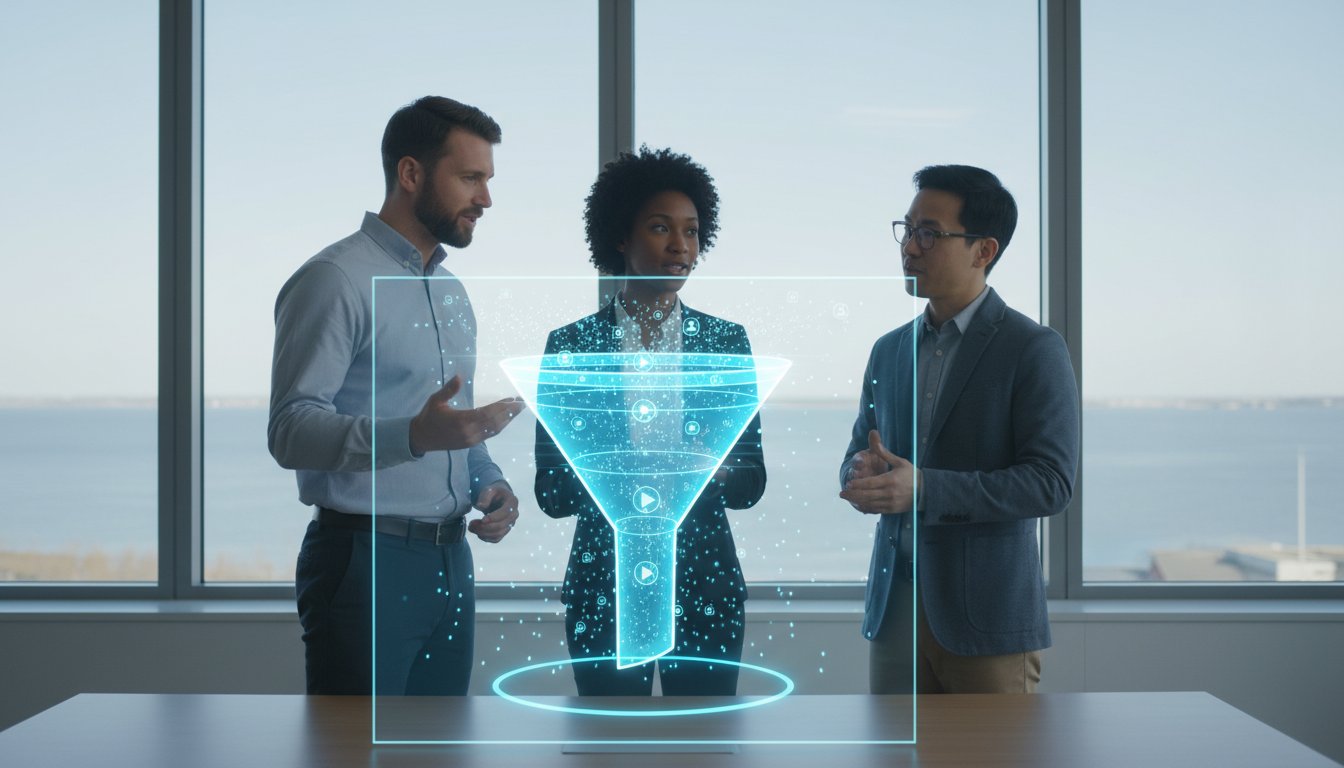
Does your company’s video content feel more like a series of expensive, one-off projects than a cohesive strategy? Many B2B leaders invest in production only to find their efforts are disconnected from the sales funnel, making it impossible to measure ROI or justify the budget.
Effective b2b video marketing is all about building a strategic system that nurtures leads from initial awareness to a final decision. Even for complex services that don’t seem “visual,” a deliberate approach can transform video from a costly experiment into a powerful revenue driver.
This guide breaks down the exact types of videos that perform best at each stage of the buyer’s journey-from top-of-funnel brand films to bottom-of-funnel case studies. You will leave with a clear strategy for planning, executing, and measuring a video strategy that delivers results, giving you the confidence to build a solid business case for your investment and turn viewers into customers.
Key Takeaways
- Stop creating one-off brand videos and learn how to build a strategic video system that nurtures leads from awareness to close.
- Discover which video formats are most effective at each stage of the funnel, from attracting your Ideal Customer Profile to enabling your sales team.
- Implement a proven framework for developing a b2b video marketing strategy that aligns directly with business objectives.
- Equip your sales team with targeted videos designed to handle final objections and accelerate the decision-making process.
Why B2B Video Marketing Demands a Full-Funnel Approach
The standard marketing methods of the B2B marketplace are becoming less effective. The idea of video as a single, high-budget brand piece is outdated. Effective b2b video marketing is all about engineering a strategic system of assets. This system functions as a main component of a modern Content Marketing strategy, designed to guide prospects through a complex and often lengthy buying journey.
The primary challenges for B2B companies is explaining complex solutions and building trust over long sales cycles. Video is uniquely equipped to solve both. It transcends the “my product is boring” objection because its goal is clarity and value demonstration. A well-executed video can break down a sophisticated software platform or manufacturing process in minutes, building the confidence required for a significant investment.
From ‘Brand Film’ to ‘Sales Engine’
The necessary mindset shift is from viewing video as an expensive vanity project to seeing it as a revenue-driving sales engine. Instead of one big hammer, think of your video strategy as a toolkit of specialized instruments. You need short-form social videos for awareness, detailed demo videos for consideration, and personalized video messages for sales enablement. Each asset has a specific job, working in concert to generate, nurture, and close leads.
B2B Video Statistics You Can’t Ignore in 2026
The data supporting a full-funnel approach to video is definitive. As we move toward 2026, B2B buyers increasingly expect and rely on video to make informed decisions. The ROI is no longer a question but a proven outcome for businesses that invest strategically.
- Buyer Preference: Over 70% of B2B buyers watch videos on their path to purchase, demonstrating a clear preference for the medium.
- Decision Impact: Nearly 90% of business executives state that product videos directly assist them in making purchase decisions.
- Conversion Power: Including a video on a landing page can increase conversion rates by over 80%, providing a measurable and immediate impact on lead generation.
Top-of-Funnel (TOFU): Videos for Awareness and Authority
At the top of the funnel, your primary goal is to attract and educate your Ideal Customer Profile (ICP). Effective b2b video marketing at this stage establishes your brand as a credible authority by focusing squarely on your prospect’s problems, not your product’s features. The objective is to build an audience that trusts your expertise. This requires a proven strategy that combines the right video formats with precise distribution on channels like LinkedIn, YouTube, and SEO-optimized blog content.
Crafting the Perfect Explainer Video
Explainer videos are powerful tools for simplifying complexity. Think of breaking down an intricate manufacturing process or a new legal compliance framework into a digestible 90-second asset. The focus is on the ‘what’ and ‘why’ to capture broad interest. A solid explainer follows a clear structure:
- Problem: Articulate a common pain point your ICP faces.
- Agitation: Detail the consequences of leaving the problem unsolved.
- High-level Solution: Introduce a new approach or category of solution, positioning your brand as the guide.
Webinars That Build Your Brand
Position your webinars as exclusive educational events, which helps attract senior decision-makers. Promote your event across professional networks and to segmented email lists to generate qualified registrations. The true ROI, however, is realized after the event. A single one-hour webinar can be repurposed into dozens of short video clips, audiograms, and quote graphics, fueling your social media calendar for weeks and extending the reach of your thought leadership.
Measuring TOFU Video Success
Direct lead attribution is the wrong metric for TOFU success. Instead, focus on metrics that signal you are building a relevant and engaged audience. As industry experts at Forbes emphasize, the goal is to transform b2b engagement with video, not just capture an immediate lead. Key performance indicators at this stage include:
- View Count & Watch Time: Are you reaching your ICP and holding their attention?
- Audience Retention: Pinpoint where viewers drop off to refine future content.
- Brand Search Lift: Are more people searching for your company name after a campaign?
These metrics demonstrate you are successfully building an audience that you can guide further down the funnel.
Middle-of-Funnel (MOFU): Videos for Nurturing and Consideration
Once a prospect is aware of their problem and your brand, the middle of the funnel is where the real work begins. The primary goal here is to nurture that initial interest, demonstrating with solid proof why your solution is the superior choice. At this stage, your b2b video marketing strategy shifts from broad awareness to focused education. This is a critical component of any effective B2B marketing program, as it directly connects the prospect’s specific pain points to the tangible benefits of your product or service. Key distribution channels for these assets include targeted email nurture sequences, retargeting ad campaigns, and dedicated landing pages.
Product Demos That Engage
A modern B2B product demo should tell a story of problem-solving. Instead of simply showing what your product does, show how it alleviates a specific pain point for a particular buyer persona. A demo for a CFO should focus on ROI and reporting, while one for an IT manager should highlight security and integration. Use clean screen recordings for software or detailed close-up shots for physical equipment to make the solution feel concrete and accessible.
Video Case Studies for Complex Industries
Nothing builds trust faster than proven success. Video case studies are the most powerful tool for this, especially in complex sectors like legal services, manufacturing, or finance. Structure the narrative clearly: outline the client’s initial challenge, walk through your implemented solution, and showcase the results. How did your product/service provide a solution for your target audience’s pain points? Featuring your team and your client’s team humanizes the partnership and transforms a simple transaction into a story of collaborative success.
Measuring MOFU Video Engagement
In the consideration stage, track metrics that signal genuine buying intent. Focus on data that drives sales conversations and proves ROI. Key performance indicators include:
- Click-Through Rates (CTR): Are viewers clicking the call-to-action to book a meeting or download a resource?
- Lead Magnet Downloads: Did the video successfully compel a prospect to exchange their information for a high-value asset?
- Viewing Data: Track which specific prospects watch key videos. This provides invaluable intelligence for your sales team.
- Engagement Heatmaps: Use video heatmaps to see which parts of your demo viewers re-watch or skip, allowing you to refine your messaging.
Bottom-of-Funnel (BOFU): Videos That Empower Sales and Close Deals
At the bottom of the funnel, marketing’s role shifts from broad education to direct sales enablement. The prospect is qualified and interested, but they may have final doubts or need to justify the decision internally. BOFU videos are precision tools designed to remove these last barriers, handle objections, and accelerate the decision-making process. These assets provide the final layer of proof and confidence needed to convert a prospect into a customer.
The Power of Authentic Customer Testimonials
No sales pitch is as powerful as the authentic words of a satisfied customer. A real client describing their success with your solution provides the social proof that decision-makers need. To capture genuine testimonials, ask clients to describe the specific business challenge they faced and the measurable results your solution delivered. These videos are exceptionally effective on pricing pages and embedded directly within proposals to build final confidence.
Personalized Video for Sales Outreach
In a world of automated emails, a personal touch stands out. Tools like Loom or Vidyard empower sales reps to record and send quick, personalized videos that build a direct connection. This tactic is a cornerstone of modern b2b video marketing for sales teams. Proven use cases include:
- Post-Demo Recaps: Briefly summarize key discussion points and next steps.
- Proposal Walk-Throughs: Guide the prospect through a proposal, highlighting the most relevant sections.
- Answering Specific Questions: Provide a detailed, visual answer to a complex question instead of a long email.
Linking BOFU Video to Revenue
Ultimately, every marketing tactic must prove its value in revenue. For BOFU video, the metrics are clear and directly tied to sales outcomes. Track metrics like demo-to-proposal conversion rates and proposal acceptance rates. By integrating video analytics with your CRM, you can see precisely which prospects watched a testimonial or a personalized walk-through before signing. This allows you to attribute revenue directly to video-driven sales conversations and prove the ROI of your b2b video marketing strategy.
Developing a video strategy that drives revenue requires a specialized approach. Contact us to learn how we connect marketing efforts to measurable success.
How to Build Your B2B Video Strategy
A successful b2b video marketing initiative is all about building a sustainable engine for lead generation. This requires a methodical, results-oriented approach. We’ve distilled the process into a proven five-step framework to guide your planning and execution.
- Step 1: Define Your Business Objectives. Start with the ‘why.’ Are you aiming to generate 20% more Marketing Qualified Leads (MQLs) or shorten the sales cycle? Your goals must be specific and measurable.
- Step 2: Map Your Buyer’s Journey. Look deep into your customer’s process. What questions do they ask at the Awareness stage? What objections arise during Consideration? Your videos should provide timely, relevant answers.
- Step 3: Select ‘Pillar’ Video Formats. Don’t try to do everything at once. Choose one main video format for each stage to start: a high-level explainer for Awareness, a detailed case study for Consideration, and a product demo for Decision.
- Step 4: Establish a Realistic Budget. Your budget determines your production capabilities. This is a strategic choice between building an internal team or engaging an expert partner to accelerate your efforts.
- Step 5: Define KPIs and Implement Measurement. Track metrics that connect to your objectives. Integrate video analytics from platforms like Wistia with your CRM to measure video’s true impact on revenue and prove ROI.
Budgeting for B2B Video: In-House vs. Agency
An in-house team offers control but requires significant investment in talent and technology. Partnering with an agency provides immediate access to specialized expertise, high-end production, and strategy. Using an agency is an investment in a partner who understands how to connect video to your bottom line.
Essential Tools and Technology
While strategy precedes gear, having the right tools is critical. For in-house teams, start with a quality camera, a three-point lighting kit, and a dedicated microphone. Key software includes an editing suite (Adobe Premiere Pro), a business-focused hosting platform (Wistia), and analytics tools to track performance.
Executing Your Strategy with a B2B Partner
A specialized agency brings industry experience and a crucial outside perspective to uncover your most compelling story. They understand the nuances of the B2B buyer and can develop a complete b2b video marketing strategy that delivers tangible results. Let’s build a video strategy that drives real business results.
Build Your B2B Video Strategy for Success
As we’ve explored, the future of B2B marketing is visual, but success hinges on more than just creating videos. It requires a strategic, full-funnel approach where every asset is purposefully designed to guide your buyer through their journey. Moving beyond isolated tactics to a cohesive, integrated b2b video marketing strategy is the key to unlocking measurable ROI and achieving your business goals.
Building this framework demands deep industry knowledge and a proven process. At CGT Marketing, we bring over 30 years of dedicated B2B marketing experience to the table. Our specialists in Manufacturing and Legal & Professional Services understand your unique challenges and deliver a results-oriented strategic approach that works. Develop a video strategy that drives results. Contact CGT Marketing today.
Frequently Asked Questions About B2B Video Marketing
How much should a B2B company budget for video marketing?
A definitive number is misleading; a budget should be a strategic investment tied to specific business objectives. A simple, in-house series of product demos may cost a few thousand dollars, while a professionally produced brand story can range from $10,000 to $50,000+. The key is to align spending with desired outcomes, such as lead generation or brand authority. Factor in costs for both production and paid distribution to maximize the impact of your B2B video marketing investment.
What is the ideal length for a B2B marketing video?
The ideal length depends entirely on the platform and the video’s purpose. For social media platforms like LinkedIn, aim for 30 to 90 seconds to capture attention quickly. Explainer or demo videos on your website can be longer, typically 2 to 5 minutes, as the audience is already engaged and seeking detailed information. The guiding principle is simple: a video should be only as long as it needs to be to deliver its core message effectively and hold the viewer’s attention.
How do you measure the ROI of B2B video marketing?
Measuring the ROI of B2B video marketing requires tracking metrics tied directly to business goals. Key performance indicators include view-through rate (VTR), click-through rate (CTR) on calls-to-action, and conversion rates on dedicated landing pages. More advanced measurement involves tracking video influence on the sales pipeline, such as the number of marketing qualified leads (MQLs) generated or the reduction in sales cycle length. Tying video analytics to your CRM provides the clearest picture of financial return.
What are the best platforms to host and share B2B videos?
For hosting, professional platforms like Wistia or Vidyard offer advanced analytics, lead generation forms, and an ad-free viewing experience ideal for your website. For sharing and distribution, LinkedIn is the premier B2B social platform for reaching decision-makers with targeted content. YouTube is essential for search visibility and building a broad audience, while targeted email campaigns remain a highly effective channel for nurturing leads with specific, high-value video content.
Can video marketing work for a ‘boring’ industry like manufacturing or accounting?
Absolutely. What some call ‘boring,’ we see as complex and specialized-a perfect opportunity for video to simplify and clarify. In manufacturing, behind-the-scenes facility tours or detailed product demonstrations build trust and showcase expertise. For accounting, videos can break down complex tax laws or feature client success stories. The goal is to provide value, educate prospects, and build credibility in a clear, accessible format that drives business results.
What’s the main difference between B2B and B2C video marketing?
The difference lies in your audience’s motivation. B2C video often appeals to emotion to drive immediate, individual purchases. In contrast, B2B video marketing targets a committee of decision-makers and focuses on logic, efficiency, and ROI. The goal is to educate and build a long-term, trust-based relationship. B2B videos must clearly articulate how a product or service solves a complex business problem and delivers measurable value to the entire organization.
How many videos do I need to get started?
Starting with a strategic set of 3 to 5 videos is more effective than producing a high volume without a clear purpose. We recommend beginning with foundational assets: a company overview or brand story video to establish who you are, a detailed product or service explainer, and one or two compelling customer testimonial videos. This initial library provides versatile content for your website, sales team, and social channels, creating a solid base for future video marketing efforts.
Should I use my employees in my marketing videos?
Using employees can be a powerful tool for building authenticity and humanizing your brand. They are your subject matter experts and can speak with genuine passion. However, it requires careful planning to ensure they appear professional and on-message. For expert interviews, culture videos, or behind-the-scenes content, employees are an excellent choice. For high-stakes brand anthems or complex product launches, professional actors may provide a more polished and controlled performance that aligns with specific campaign goals.
Leave a Reply